
The Madaxeman
Madaxeman.com's Home Page
  • Home
  • Latest Posts
  • Links Page
  • Battle Reports
  • ADLG Index
  • ADLG Wiki
  • Malifaux
  • C London Club
  • 15mm Gallery
  • 15mm Suppliers
  • Facebook
  • The Podcast
  • 10mm
  • Consent Preferences
 RSS Feed

Madaxemans 10mm & Real World Photo Gallery

Photos from museums, and from my 10mm wargaming collection

  • Home
  • Login
  • Album list
    • Last uploads
    • Last comments
    • Most viewed
    • Top rated
    • By date
    • My Favorites
  • Search

The 10mm & Real World Museums Photo Directory - helping you choose the best 10mm tanks, or dig out real cammo schemes from tanks and other military vehicles in museums and shows around the world. You can also search the directory by manufacturer, army or keyword

Anyone can rate the photos just by clicking on the stars beneath each photo. Ratings use a scale of 0-5 where 5 = excellent and 0 = terrible.

Home > Museums and Shows

Most viewed - Museums and Shows
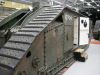
IMGP0617.JPG
WW1 British tanks183 viewsThe British Mark I-V series were tracked vehicles developed by the British Army during the First World War, and the world's first combat tanks. Born of the need to break the domination of trenches and machine guns over the battlefields of the Western Front, they were the first vehicles to be named "tank", a name chosen as an expedient to maintain secrecy and to disguise its true purpose. It was developed to be able to cross trenches, resist small-arms fire, travel over difficult terrain
PICT1714.JPG
WW1 Tank183 viewsThe prototype Mark I, ready in December 1915, was called "Mother" (previous names having been "The Wilson Machine", "Big Willie", and "His Majesty's Land Ship Centipede"). Mother was successfully demonstrated to the Landships Committee in early 1916; it was run around a course simulating the front including trenches, parapets, craters and barbed wire obstacles
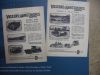
PICT1721.JPG
Viskers advert interwar period183 views
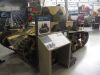
PICT1728.JPG
Vickers Mk E Tank183 viewsThe British Army evaluated the Mark E, but rejected it, apparently due to questions about the reliability of the suspension. Vickers then started advertising the design to all buyers, and soon received a trickle of orders eventually including USSR, Greece, Poland, Bolivia, Siam, Finland, Portugal, China and Bulgaria. A Thai order was placed, but taken over by the British when the war started. Vickers built a total of 153 (the most common figure) Mark E's.
PICT1776.JPG
T34/85183 viewsThe T-43's turret design was hurriedly adapted by V. Kerichev at the Krasnoye Sormovo Factory to fit the T-34. This was seen as a compromise between advocates for the T-43, and others in the high command who wanted to continue to build as many 76 mm armed T-34s as possible, without interruption. The resulting new T-34-85 tank had a much better gun and finally, a three-man turret with radio (which had previously been in the hull). Now the commander needed only to command the tank,
PICT1786.JPG
Cromwell183 viewsTank, Cruiser, Mk VIII, Cromwell (A27M), and the related Centaur (A27L) tank, were one of the most successful series of cruiser tanks fielded by Britain in the Second World War. The Cromwell tank, named after the English Civil War leader Oliver Cromwell, was the first tank put into service by the British to combine a dual-purpose gun, high speed from the powerful and reliable Meteor engine, and reasonable armour, all in one balanced package. Its design formed the basis of the Comet tank.
PICT1788.JPG
Sherman183 viewsThe Army had seven main sub-designations for M4 variants during production: M4, M4A1, M4A2, M4A3, M4A4, M4A5, and M4A6. These designations did not necessarily indicate linear improvement: for example, A4 was not meant to indicate it was better than the A3. These sub-types indicated standardized production variations, which were in fact often manufactured concurrently at different locations
PICT1791.JPG
DD Sherman183 viewsDD tanks worked by erecting a 'flotation screen' around the tank, which enabled it to float, and had a propeller powered by the tank's engine to drive them in the water.
The DD tanks were one of the many specialised assault vehicles, collectively known as Hobart's Funnies, devised to support the planned invasion of Europe
PICT1799.JPG
Cromwell183 viewsTotal A27 production consisted of 4,016 tanks; 950 of which were Centaurs and 3,066 Cromwells. In addition, 375 Centaur hulls were built to be fitted with an anti-aircraft gun turret; only 95 of these were completed.
IMG_0410.JPG
183 views
2226 files on 223 page(s) 1 - 116 117 118 119 120 121 122 123 124 125 - 223


Visit Madaxeman on

Youtube Logo
Blogger Logo
Facebook Logo
Podbean Logo
Twitter Logo
Spotify Logo
Pinterest Logo
iTunes Logo
Tune In Logo

Podcasts to download from Madaxeman.com

(Also available on Podbean, iTunes and Spotify)


(These are "affiliate links". If you buy something after clicking on them I get a small kickback from eBay)

Page Loads for the 10mm & Museums Gallery:

About This Site & Privacy Information

Powered by Coppermine Photo Gallery