
The Madaxeman
Madaxeman.com's Home Page
  • Home
  • Latest Posts
  • Links Page
  • Battle Reports
  • ADLG Index
  • ADLG Wiki
  • Malifaux
  • C London Club
  • 15mm Gallery
  • 15mm Suppliers
  • Facebook
  • The Podcast
  • 10mm
  • Consent Preferences
 RSS Feed

Madaxemans 10mm & Real World Photo Gallery

Photos from museums, and from my 10mm wargaming collection

  • Home
  • Login
  • Album list
    • Last uploads
    • Last comments
    • Most viewed
    • Top rated
    • By date
    • My Favorites
  • Search

The 10mm & Real World Museums Photo Directory - helping you choose the best 10mm tanks, or dig out real cammo schemes from tanks and other military vehicles in museums and shows around the world. You can also search the directory by manufacturer, army or keyword

Anyone can rate the photos just by clicking on the stars beneath each photo. Ratings use a scale of 0-5 where 5 = excellent and 0 = terrible.

Most viewed
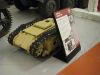
IMGP0577.JPG
Goliath175 viewsThe Goliath tracked mine - complete German name: Leichter Ladungsträger Goliath (Sd.Kfz. 302/303a/303b) - was a remote controlled German-engineered demolition vehicle, also known as the beetle tank Employed by the Wehrmacht during World War II, this caterpillar-tracked vehicle was approximately 4 feet (1.2 m) long, 2 feet (0.61 m) wide, and 1 foot (0.30 m) tall. It carried 75–100 kilograms (170–220 lb) of high explosives and was intended to be used for multiple purposes, such as destroying tanks, disrupting dense infantry formations, and demolition of buildings and bridges.
IMGP0600.JPG
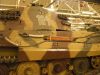
King Tiger showing Zimmerit175 viewsZimmerit was a non-magnetic coating produced for German armored fighting vehicles during World War II for the purpose of combating magnetically attached anti-tank mines, although Germany was the only country to use magnetically adhered mines against tanks in any significant number. It was developed by the German company Chemische Werke Zimmer AG
IMGP0613.JPG
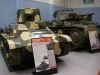
Vickers-Armstrong Commercial export tank175 viewsThe company was also known for its tank designs, starting with the widely used Vickers 6-Ton. It also produced the influential, if never actually produced, Independent A1E1 tank. One of the company's most important designs was the Valentine Infantry Tank, produced in the thousands in World War II. The military vehicle manufacturing interests were divested into Vickers plc, and would later pass to Alvis Vickers, now part of BAE Systems Land and Armaments.
IMGP0618.JPG
WW1 British tanks175 viewsThe Mark I entered service in August 1916, and was first used in action on the morning of 15 September 1916 during the Battle of Flers-Courcelette, part of the Somme Offensive. With the exception of the few interim Mark II and Mark III tanks, it was followed by the largely similar Mark IV, which first saw combat in June 1917. The Mark IV was used en masse at the Battle of Cambrai in November 1917 The Mark V, with its much improved transmission, entered service in mid-1918.
PICT1758.JPG
The Tiger I175 viewsAlthough the general design and layout were broadly similar to the previous medium tank, the Panzer IV, the Tiger weighed more than twice as much. This was due to its substantially thicker armour, the larger main gun, greater volume of fuel and ammunition storage, larger engine, and more solidly-built transmission and suspension.
PICT1761.JPG
The Tiger I175 viewsFrom a 30 degree angle the Tiger's 88mm gun was capable of penetrating the front glacis plate of an American M4 Sherman between 1,800 and 2,100 m (1.1 and 1.3 mi), the British Churchill IV between 1,100 and 1,700 m (0.68 and 1.1 mi), the Soviet T-34 between 800 and 1,400 m (0.50 and 0.87 mi), and the Soviet IS-2 between 100 and 300 m (0.062 and 0.19 mi)
PICT1779.JPG
Panther175 viewsUntil 1944, it was designated as the Panzerkampfwagen V Panther and had the ordnance inventory designation of Sd.Kfz. 171. On 27 February 1944, Hitler ordered that the Roman numeral V be deleted from the designation.
PICT1781.JPG
Panther175 viewsThe Panther proved to be deadly in open country and long range engagements, but vulnerable in close-quarters combat. Also, the 75 mm gun fired a slightly smaller shell than the Tiger's 88 mm gun, providing less high explosive firepower against infantry.
PICT1792.JPG
Cromwell175 viewsThe Cromwell and the related Centaur were the product of further development of British cruiser tanks, and they were designed as the replacement for the Crusader tank, which although not yet in service would become obsolete in time. In late 1940, the General Staff set out the specifications for the new tank, and designs were submitted in early 1941. The tank would be fitted with the QF 6 pounder gun with the expectation that it would enter service in 1942.
IMGP5028.JPG
PT76B175 viewsThe PT-76 is a Soviet amphibious light tank that was introduced in the early 1950s and soon became the standard reconnaissance tank of the Soviet Army and the other Warsaw Pact armed forces. It was widely exported to other friendly states, like India, Iraq, Syria, North Korea and North Vietnam. Overall, some 25 countries used the PT-76
3463 files on 347 page(s) 1 - 206 207 208 209 210 211 212 213 214 215 - 347


Visit Madaxeman on

Youtube Logo
Blogger Logo
Facebook Logo
Podbean Logo
Twitter Logo
Spotify Logo
Pinterest Logo
iTunes Logo
Tune In Logo

Podcasts to download from Madaxeman.com

(Also available on Podbean, iTunes and Spotify)


(These are "affiliate links". If you buy something after clicking on them I get a small kickback from eBay)

Page Loads for the 10mm & Museums Gallery:

About This Site & Privacy Information

Powered by Coppermine Photo Gallery