
The Madaxeman
Madaxeman.com's Home Page
  • Home
  • Latest Posts
  • Links Page
  • Battle Reports
  • ADLG Index
  • ADLG Wiki
  • Malifaux
  • C London Club
  • 15mm Gallery
  • 15mm Suppliers
  • Facebook
  • The Podcast
  • 10mm
  • Consent Preferences
 RSS Feed

Madaxemans 10mm & Real World Photo Gallery

Photos from museums, and from my 10mm wargaming collection

  • Home
  • Login
  • Album list
    • Last uploads
    • Last comments
    • Most viewed
    • Top rated
    • By date
    • My Favorites
  • Search

The 10mm & Real World Museums Photo Directory - helping you choose the best 10mm tanks, or dig out real cammo schemes from tanks and other military vehicles in museums and shows around the world. You can also search the directory by manufacturer, army or keyword

Anyone can rate the photos just by clicking on the stars beneath each photo. Ratings use a scale of 0-5 where 5 = excellent and 0 = terrible.

Most viewed
IMGP7266.JPG
185 viewsIn the land warfare hall
IMGP0091.JPG
A dirty great truck 185 viewsPhotos of AFVs at the IDEX 2013 exhibition
IMGP0590.JPG
Tiger II185 viewsThe Tiger II was developed late in the war and built in relatively small numbers - 1,500 Tiger IIs were ordered, but production was severely disrupted by Allied bombing. Among others, five raids between 22 September and 7 October 1944 destroyed 95 percent of the floor area of the Henschel plant. It is estimated that this caused the loss in production of some 657 Tiger IIs. Only 492 units were produced: one in 1943, 379 in 1944, and 112 in 1945. Full production ran from mid-1944 to the end of the war
PICT1740.JPG
Char B 185 viewsAmong the most powerfully armed and armoured tanks of its day, the type was very effective in direct confrontations with German armour in 1940 during the Battle of France, but slow speed and high fuel consumption made it ill-adapted to the war of movement then being fought. After the defeat of France captured Char B1 (bis) would be used by Germany, with some rebuilt as flamethrowers or mechanised artillery
PICT1748.JPG
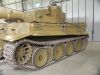
The Tiger I185 viewsThe Tiger differed from earlier German tanks principally in its design philosophy. Its predecessors balanced mobility, armour and firepower, and were sometimes outgunned by their opponents.
The Tiger I represented a new approach that emphasised firepower and armour. While heavy, this tank was not slower than the best of its opponents.
PICT1761.JPG
The Tiger I185 viewsFrom a 30 degree angle the Tiger's 88mm gun was capable of penetrating the front glacis plate of an American M4 Sherman between 1,800 and 2,100 m (1.1 and 1.3 mi), the British Churchill IV between 1,100 and 1,700 m (0.68 and 1.1 mi), the Soviet T-34 between 800 and 1,400 m (0.50 and 0.87 mi), and the Soviet IS-2 between 100 and 300 m (0.062 and 0.19 mi)
PICT1762.JPG
Matilda II185 viewsThe tank's suspension system was that which had been developed by Vickers for their Medium C prototype in the mid-1920s.[22] The tank was carried by five double wheel bogies on each side. Four of the bogies were on bellcranks in pairs with a common horizontal coil spring. The fifth, rearmost, bogie was sprung against a hull bracket. Between the first bogie and the idler wheel was a larger diameter vertically sprung "jockey wheel"
PICT1766.JPG
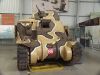
Lee/Grant185 viewsBritish Lees and Grants were in action against Rommel's forces at the disastrous Battle of Gazala on 27 May that year. They continued to serve in North Africa until the end of that campaign. A regiment of M3 Mediums was also used by the U.S. 1st Armored Division in North Africa. In the North African campaign, the M3 was generally appreciated for its mechanical reliability, good armor and heavy firepower.
PICT1780.JPG
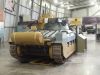
Panther185 viewsThe Panther tank was a compromise of various requirements. While having essentially the same engine as the Tiger I tank, it had better frontal armor (including the benefit of a sloped armor, increasing effective armor depth), better gun penetration, was lighter and thus faster, and could traverse rough terrain better than the Tigers. The tradeoff was weaker side armor.
PICT1781.JPG
Panther185 viewsThe Panther proved to be deadly in open country and long range engagements, but vulnerable in close-quarters combat. Also, the 75 mm gun fired a slightly smaller shell than the Tiger's 88 mm gun, providing less high explosive firepower against infantry.
3464 files on 347 page(s) 1 - 190 191 192 193 194 195 196 197 198 199 - 347


Visit Madaxeman on

Youtube Logo
Blogger Logo
Facebook Logo
Podbean Logo
Twitter Logo
Spotify Logo
Pinterest Logo
iTunes Logo
Tune In Logo

Podcasts to download from Madaxeman.com

(Also available on Podbean, iTunes and Spotify)


(These are "affiliate links". If you buy something after clicking on them I get a small kickback from eBay)

Page Loads for the 10mm & Museums Gallery:

About This Site & Privacy Information

Powered by Coppermine Photo Gallery