
The Madaxeman
Madaxeman.com's Home Page
  • Home
  • Latest Posts
  • Links Page
  • Battle Reports
  • ADLG Index
  • ADLG Wiki
  • Malifaux
  • C London Club
  • 15mm Gallery
  • 15mm Suppliers
  • Facebook
  • The Podcast
  • 10mm
  • Consent Preferences
 RSS Feed

Madaxemans 10mm & Real World Photo Gallery

Photos from museums, and from my 10mm wargaming collection

  • Home
  • Login
  • Album list
    • Last uploads
    • Last comments
    • Most viewed
    • Top rated
    • By date
    • My Favorites
  • Search

The 10mm & Real World Museums Photo Directory - helping you choose the best 10mm tanks, or dig out real cammo schemes from tanks and other military vehicles in museums and shows around the world. You can also search the directory by manufacturer, army or keyword

Anyone can rate the photos just by clicking on the stars beneath each photo. Ratings use a scale of 0-5 where 5 = excellent and 0 = terrible.

Home > Museums and Shows > Bovington

Most viewed - Bovington
PICT1786.JPG
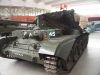
Cromwell169 viewsTank, Cruiser, Mk VIII, Cromwell (A27M), and the related Centaur (A27L) tank, were one of the most successful series of cruiser tanks fielded by Britain in the Second World War. The Cromwell tank, named after the English Civil War leader Oliver Cromwell, was the first tank put into service by the British to combine a dual-purpose gun, high speed from the powerful and reliable Meteor engine, and reasonable armour, all in one balanced package. Its design formed the basis of the Comet tank.
PICT1799.JPG
Cromwell169 viewsTotal A27 production consisted of 4,016 tanks; 950 of which were Centaurs and 3,066 Cromwells. In addition, 375 Centaur hulls were built to be fitted with an anti-aircraft gun turret; only 95 of these were completed.
PICT1733.JPG
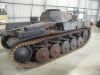
Pz II168 viewsThe Panzer II is the common name used for a family of German tanks used in World War II. The official German designation was Panzerkampfwagen II (abbreviated PzKpfw II).
Although the vehicle had originally been designed as a stopgap while larger, more advanced tanks were developed, it nonetheless went on to play an important role in the early years of World War II, during the Polish and French campaigns. The Panzer II was the most numerous tank in the German Panzer divisions beginning with the invasion of France. It was used in both North Africa against the British and on the Eastern Front against the Soviet Union.
PICT1751.JPG
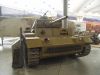
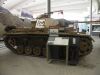
Pz III168 viewsThe Panzer III was used in the campaigns against Poland, France, the Soviet Union and in North Africa. A handful were still in use in Normandy, Anzio, Norway, Finland and in Operation Market Garden in 1944
PICT1752.JPG
Pz III168 viewsThe Panzer III was intended as the primary battle tank of the German forces. However, when it initially met the KV and T-34 tanks it proved to be inferior in both armor and gun power. To meet the growing need to counter these tanks, the Panzer III was up-gunned with a longer, more powerful 50-millimetre (1.97 in) cannon and received more armour although this failed to effectively address the problem caused by the KV tank designs.
PICT1757.JPG
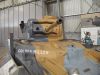
Matilda II168 viewsWhile the Matilda possessed a degree of protection that was then unmatched in the North African theatre, the sheer weight of the armour mounted on the vehicle contributed to a very low average speed of about 6 mph (9.7 km/h) on desert terrain. At the time, this was not thought to be a problem since British infantry tank doctrine prioritized heavy armour and trench-crossing ability over speed and cross-country mobility (which was considered to be characteristic of cruiser tanks such as the Crusader)
PICT1763.JPG
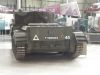
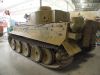
The Tiger I168 views Generally speaking, it took about twice as long to build a Tiger I as another German tank of the period. When the improved Tiger II began production in January 1944, the Tiger I was soon phased out.
PICT1789.JPG
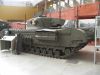
Churchill Crocodile168 viewsThe Churchill Crocodile was a British flame-throwing tank of late Second World War. It was a variant of the Tank, Infantry, Mk VI (A22) Churchill Mark VII, although the Churchill Mark IV was initially chosen to be the base vehicle.
The Crocodile was introduced as one of the specialised armoured vehicles developed under Major-General Percy Hobart, informally known as "Hobart's Funnies". It was produced from October 1943, in time for the Normandy invasion.
PICT1793.JPG
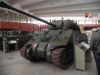
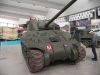
Sherman 17pdr168 viewsResearch conducted by the British No. 2 Operational Research Section, after the Normandy campaign, concluded a Sherman would be set alight 82% of the time following an average of 1.89 penetrations of the tank’s armor; in comparison they also concluded the Panzer IV would catch fire 80% of the time following an average of 1.5 penetrations, the Panther would light 63% of the time following 3.24 penetrations, and the Tiger would catch fire 80% of the time following 3.25 penetrations
PICT1794.JPG
Sherman168 viewsThe armor of the M4 was effective against most early war anti-tank weapons, but was easily penetrated by later German tank guns and anti-tank guns. Early versions had unfortunate shot traps, locations where the effect of slope was greatly reduced, located just in front of the driver and assistant driver.
270 files on 27 page(s) 1 - 17 18 19 20 21 22 23 24 25 26 27


Visit Madaxeman on

Youtube Logo
Blogger Logo
Facebook Logo
Podbean Logo
Twitter Logo
Spotify Logo
Pinterest Logo
iTunes Logo
Tune In Logo

Podcasts to download from Madaxeman.com

(Also available on Podbean, iTunes and Spotify)


(These are "affiliate links". If you buy something after clicking on them I get a small kickback from eBay)

Page Loads for the 10mm & Museums Gallery:

About This Site & Privacy Information

Powered by Coppermine Photo Gallery