
The Madaxeman
Madaxeman.com's Home Page
  • Home
  • Latest Posts
  • Links Page
  • Battle Reports
  • ADLG Index
  • ADLG Wiki
  • Malifaux
  • C London Club
  • 15mm Gallery
  • 15mm Suppliers
  • Facebook
  • The Podcast
  • 10mm
  • Consent Preferences
 RSS Feed

Madaxemans 10mm & Real World Photo Gallery

Photos from museums, and from my 10mm wargaming collection

  • Home
  • Login
  • Album list
    • Last uploads
    • Last comments
    • Most viewed
    • Top rated
    • By date
    • My Favorites
  • Search

The 10mm & Real World Museums Photo Directory - helping you choose the best 10mm tanks, or dig out real cammo schemes from tanks and other military vehicles in museums and shows around the world. You can also search the directory by manufacturer, army or keyword

Anyone can rate the photos just by clicking on the stars beneath each photo. Ratings use a scale of 0-5 where 5 = excellent and 0 = terrible.

Home > Museums and Shows > Bovington

Most viewed - Bovington
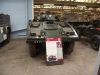
PICT1833.JPG
Vixen Armoured Car187 viewsThe FV721 Fox Combat Vehicle Reconnaissance (Wheeled) (CVR(W)) was a 4x4 armoured car deployed by the British Army as a replacement for the Ferret scout car and the Saladin Armoured Car. The Fox was introduced into service in May 1973 and withdrawn in 1993/4. FV722 Vixen - Un-turreted version, was planned and trialled but never entered production. An example of the Vixen is held at the Bovington museum. Hull #2 is in restored & running condition in Australia.
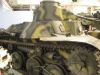
IMGP0564.JPG
Type 95 Japanese tank186 viewsThe primary armament of the most produced version was a Type 98 37 mm gun with the barrel length of 46.1[3] calibers. It elevated between −15 to +20 degrees. The tank carried two types of 37 mm ammunition, the high-explosive and armor-piercing. For the latter, muzzle velocity was 675–700 m/s, and the armor penetration was 25 mm at a distance of 500 m.
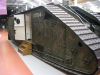
IMGP0619.JPG
WW1 British tanks186 viewsThe Mark I was a rhomboid vehicle with a low centre of gravity and long track length, able to negotiate broken ground and cross trenches. Main armament was carried in sponsons on the hull sides. The hull was undivided internally; the crew shared the same space as the engine.
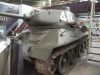
PICT1772.JPG
T34/85186 viewsThe T-34 was a Soviet medium tank produced from 1940 to 1958. When it first appeared on the battlefield in 1941, German tank generals von Kleist and Guderian called it "the deadliest tank in the world."
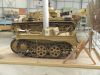
PICT1771.JPG
Kettenrad186 viewsSteering the Kettenkrad was accomplished by turning the handlebars: Up to a certain point only the front wheel would steer the vehicle. A motion of the handlebars beyond that point would engage the track brakes to help make turns sharper. It was also possible to run the vehicle without the front wheel installed and this was recommended in extreme off-road conditions where speed would be kept low
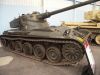
PICT1836.JPG
AMX 13186 viewsIncluding prototypes and export versions there are over a hundred variants including self-propelled gun, anti-aircraft systems, APCs, and ATGM versions. Total production of the AMX-13 family is approximately 7,700 units, around 3,400 of which were exported.
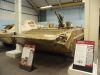
PICT1843.JPG
BMP 2186 viewsThe BMP-2 is broadly similar to the BMP-1. The most significant changes are:
A new two-man turret armed with the 2A42 30 mm autocannon and the 9P135M ATGM launcher capable of firing SACLOS guided 9M111 "Fagot" (AT-4 Spigot), 9M113 "Konkurs" (AT-5 Spandrel) and 9M113M "Konkurs-M" (AT-5B Spandrel B) anti-tank missiles.
The commander now sits with the gunner in an enlarged turret.
Seven troops are carried instead of eight.
Two rear infantry roof hatches instead of three.
Slightly improved armour.
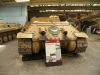
PICT1842.JPG
SU 100186 viewsThe SU-100 was a Soviet casemate-style tank destroyer. It was used extensively during the last year of World War II and saw service for many years afterwards with the armies of Soviet allies around the world.
IMGP0580.JPG
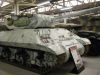
M10 Tank Destroyer185 viewsThe M10 tank destroyer, formally 3-inch Gun Motor Carriage, M10 was a United States tank destroyer of World War II based on the chassis of the M4 Sherman tank. It was numerically the most important U.S. tank destroyer of World War II and combined a reasonably potent anti-tank weapon with a turreted platform (unlike the previous M3 GMC, whose gun was capable of only limited traverse). Despite the introduction of more-powerful types as replacements, it remained in service until the end of the war. Some of those replacements were in fact modified and/or rebuilt from the M10 itself.
IMGP0609.JPG
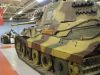
King Tiger185 viewsLike the Tiger I, each tank was issued with two sets of tracks: a normal "battle track" and a narrower "transport" version used during rail movement. The transport tracks reduced the overall width of the load and could be used to drive the tank short distances on firm ground. The crew were expected to change to normal battle tracks as soon as the tank was unloaded
270 files on 27 page(s) 1 - 9 10 11 12 13 14 15 16 17 18 - 27


Visit Madaxeman on

Youtube Logo
Blogger Logo
Facebook Logo
Podbean Logo
Twitter Logo
Spotify Logo
Pinterest Logo
iTunes Logo
Tune In Logo

Podcasts to download from Madaxeman.com

(Also available on Podbean, iTunes and Spotify)


(These are "affiliate links". If you buy something after clicking on them I get a small kickback from eBay)

Page Loads for the 10mm & Museums Gallery:

About This Site & Privacy Information

Powered by Coppermine Photo Gallery